.jpg)
How Yanzi Showcased His Ruler's Kindness

Around 2500 years ago, during the Spring and Autumn period of China's history, Duke Jing was the ruler of the State of Qi, and Yanzi was one of his trusted ministers.
One day, Duke Jing was drinking wine, and one of his ministers, Tian Huanzi, was attending by his side. After a while, Tian Huanzi saw Yanzi approaching from a distance and reported to Duke Jing, "Please penalize Yanzi by making him drink wine."
Perplexed, Duke Jing asked, "What is the reason for your request?"
Huanzi replied, "Your Highness, look at Yanzi. He wears cheap cloth and a coarse deer-pelt coat, and he rides to court in a worn-out cart drawn by an inferior horse. This is hiding the bountiful rewards Your Highness has bestowed upon him."
(Pause: If you were Duke Jing, how would you respond?)
Hearing this, Duke Jing found it reasonable and sighed, "Indeed!"
Therefore, after Yanzi paid his respects to Duke Jing and took his seat, the wine-pourer presented a cup to him and said, "The Duke penalizes you to drink."
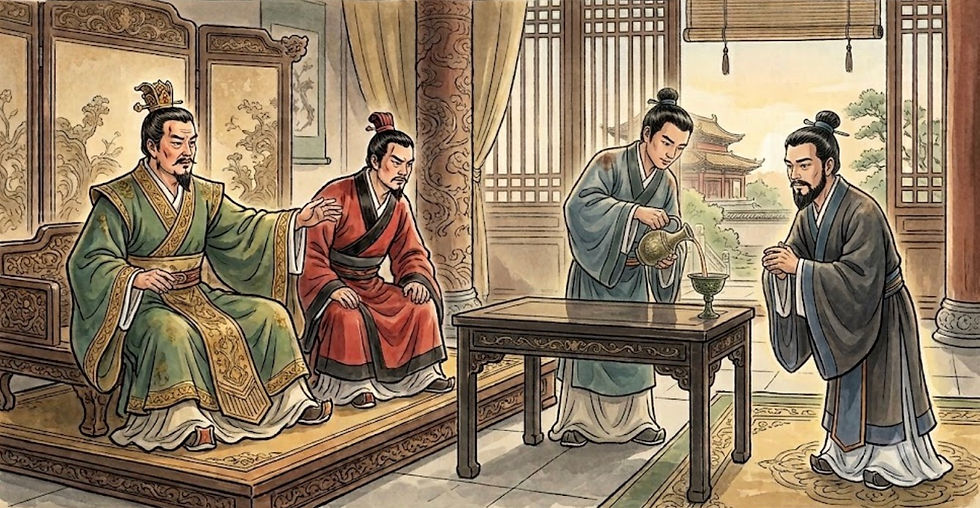
Surprised, Yanzi asked, "May I ask the reason?"
Huanzi spoke up, "The Duke granted you the rank of a high minister to honor your status, and gave you a million coins to enrich your household. Among all the ministers, none holds a title more noble than yours, and none receives a stipend more generous than yours. Yet, you wear cloth garments and a deer-pelt coat, and ride to court in a worn-out cart and an inferior horse. This is hiding the Duke's kindness from the public. Therefore, you must be penalized with a drink."
(Pause: If you were Yanzi, how would you respond?)
Upon hearing this, Yanzi left his mat, stood up, and addressed Duke Jing: "Should your humble servant drink this penalty wine first and then explain, or explain first and then drink?"
Duke Jing replied, "Explain first, then drink the penalty wine."
Yanzi said:
"Your Highness granted me the rank of a high minister to honor me, but I, Yan Ying, dare not accept this appointment for the sake of personal nobility; I accept it to carry out your commands.
Your Highness granted me a million coins to enrich my household, but I dare not accept this wealth for personal gain; I accept it so that your benevolence may reach more people, thereby showcasing your kindness.
I have heard that if the wise rulers of the past knew that a minister received a generous salary but failed to care for his impoverished relatives, they would reprimand him. If they knew a minister held office but failed to fulfill his responsibilities, they would reprimand him.
If the ruler's close relatives or my own paternal elders and brothers are left scattered and neglected in the wild, that is my fault. If the ruler’s distant relatives or my own acquaintances are left displaced and wandering, that is my fault. If our armor is weak and our war chariots are flimsy, that too is my fault. But as for riding to court in a worn-out cart and an inferior horse, I believe this is truly not my fault.
Furthermore, because of your generosity towards me, among my paternal relatives, there is none who does not ride in a carriage; among my maternal relatives, there is none who lacks food or clothing; among my wife's relatives, there is none who suffers from hunger or cold. In addition, there are hundreds of poor scholars throughout the state who rely on my assistance to survive. In a situation like this, am I hiding the ruler's kindness, or am I showcasing it?"
Hearing this, Duke Jing was deeply moved and exclaimed, "Excellent! In that case, let us penalize Huanzi with a cup on my behalf!"
Commentary
Lao Zi said,
"I have three treasures that I constantly hold firmly to: first is compassion, second is frugality, and third is not presuming to be at the head of the world. Compassion enables courage. Frugality enables broadness. Not presuming to be at the head of the world enables talent."
Yanzi's role modeling showcases all three virtues.

Firstly, he has a lot of compassion for others. He can't bear to see people impoverished, lacking food or clothing, which is why he does his best to help these people, starting with those closest to him (i.e., his relatives), then extending out to people in society (i.e., poor scholars). When the ruler criticized and wanted to punish him, he had no fear because he knew what he did was morally right. He could courageously explain to the ruler his reasoning. Thus, compassion enables courage.
Second, he was very frugal. He wore clothes to keep warm, not to show off. He rode a carriage simply for transportation, not to show off. He focused on functionality, not extravagance. He was frugal not to save money for himself, but to save money to help more and more people. Thus, frugality enables broadness of heart.
Third, he was very humble. When the ruler ordered him to drink wine as punishment, he didn't immediately argue back and say, "But I didn't do anything wrong!"
Instead, he respectfully asked Duke Jing, "Should your humble servant drink this penalty wine first and then explain, or explain first and then drink?" Since Duke Jing felt respected, he would be more open to hearing Yanzi's explanation.
Although Yanzi himself didn't really want to accept so much wealth and rank from the ruler, he still obeyed the ruler, and he used it to help the public.
After explaining himself, Yanzi didn't say, "So you see, clearly, I am not hiding the kindness of the ruler. I am showcasing it!" He said, "In a situation like this, am I hiding the ruler's kindness, or am I showcasing it?"
He was never arrogant, thinking himself to be definitely right, or thinking himself equal to his ruler. He always maintained a humble attitude. It's surely because of his humility that he could learn and cultivate such a virtuous character. Moreover, when others see his great role modeling, they would be inspired too. Thus, humility enables talent for both oneself and others.
Although we might not be ministers receiving a generous salary from a ruler, we might receive generous gifts from others. In such a situation, how would you respond?
I imagine Yanzi would act according to rules of etiquette. It's appropriate to politely decline at first, saying that it's too much. But if they insist, we shouldn't be stubborn. We can accept it and help share their gift with others, thereby showcasing their generosity.
We might also be in a financially well-off situation. Or we might already be very frugal. What do we do with extra money? Are we just keeping it for our future use? Or for our children? Or can we broaden our heart like Yanzi and use our extra wealth to help those in need, starting with relatives and then extending out to those in society?
When others criticize us, do we immediately argue our innocence? Do we explain our rationale and then tell them definitely that they are wrong? Or can we be humble like Yanzi?
Conclusion
Yanzi was a person that Confucius admired, and from his stories, it's pretty clear why! Although Laozi never mentioned Yanzi, I believe that Laozi would praise Yanzi too because Yanzi also role models Laozi's three treasures: compassion, frugality, and humility.
As for us, admiration is not enough. We need to emulate his virtues in our daily life. In this way, Yanzi and the past sages would be proud of us.
Weekly Wisdom #405


Comments