.jpg)
How Yanzi Responded to an Unadvisable Ruler

Around 2500 years ago, during the Spring and Autumn period of China's history, Duke Ling was the ruler of the State of Qi (before Duke Jing). In the seventeenth year of King Ling of Zhou, the State of Jin led the forces of various feudal lords to attack the State of Qi. Duke Ling led his troops to resist at Pingyin, but he was defeated and fled, passing away the following year.
After Duke Ling’s death, Duke Zhuang of Qi succeeded the throne. Duke Zhuang valued brute force and disregarded morality and ethics. He was indulgent in desires, fond of violence, and addicted to lust. As a result, the moral atmosphere of Qi declined day by day, causing widespread resentment and complaints among both the court and the general population.
At the time, Yanzi served Duke Zhuang as a minister, and he repeatedly tried to advise Duke Zhuang to correct his ways. However, Duke Zhuang refused to listen and grew to dislike Yanzi.
One time, while drinking wine, Duke Zhuang summoned Yanzi. After Yanzi entered and took his seat, Duke Zhuang commanded the musicians to perform a song. The lyrics of the song included a line that said, "Enough! Enough! I am displeased! What are you doing here?"

The musicians played this song three times.
(Pause: If you were Yanzi, what would you think?)
Eventually, Yanzi realized that the song was directed at him. Yanzi then left his mat, stood up, and sat directly on the ground facing north.
Seeing this, Duke Zhuang asked, "What are you doing? Why are you sitting on the ground?"
Yanzi replied:
"I have heard that when a wife is about to argue with her husband, she sits on the ground. Today, I am about to argue with my ruler. How would I dare not sit on the ground?
I have also heard that possessing a large force without advocating for righteousness, being powerful without observing propriety, and being fond of bravery while despising the virtuous is a path that invites self-destruction, where disaster will inevitably fall upon oneself, just like Your Highness's situation today. If my words of advice are not welcome here, then please allow me to resign from my current position."

(Pause: If you were Duke Zhuang, what would you do?)
Having finished speaking, Yanzi immediately stood up and departed quickly. Seeing him leave, Duke Zhuang made no effort to stop him.
Upon returning home, Yanzi returned all valuable items in his household back to the public treasury, and sent all sellable goods to the market. Yanzi remarked:
"When an exemplary person has the capability to serve the people, he enjoys rank and stipend, accepting even the most abundant rewards without refusal. But when he lacks the opportunity to serve the people, even if he must live in a foreign land as a guest and endure a poor and humble life, he should not despise it."
He then walked east to live as an ordinary citizen in a small village on the coast of the East Sea. A few years later, a rebellion broke out in Qi, and Duke Zhuang was assassinated.
Later, Yanzi met Duke Jing of Qi, who valued Yanzi's abilities and wisdom and invited Yanzi to help him rule the state and benefit the people. With Duke Jing, Yanzi became a renowned minister of his generation.
Commentary
Although Yanzi was extremely capable and wise, if he did not have a leader who could recognize and value his abilities, he wouldn't be able to contribute his services to the state. Confucius also faced the same situation. Thus, if we feel like our abilities are not recognized by others, we shouldn't get upset. Chances are, we're nowhere near as capable as Confucius and Yanzi. If even sages like them get ignored and misunderstood, we're all the more likely.
As Confucius said in the Analects,
"To not be upset when not understood by others, is this not the mark of an exemplary person?"
(Original Text: 人不知而不慍不亦君子乎。)
This doesn't mean we should be dejected or passive. We should always do our best to do everything in our control. Reflecting on ourselves, do we recognize our own talents and strengths?
If not, how can we expect others to? If we do know our strengths, do we proactively communicate with our leader to help them leverage our strengths? If we don't communicate, they might not realize it. If we do communicate, are we respectful and patient in our communication? Otherwise, we might upset our leader.
In Yanzi's case, he repeatedly tried to advise Duke Zhuang, and he was always respectful in his communication. However, Duke Zhuang disliked Yanzi and even indirectly told him to leave. Duke Zhuang accelerated his demise by eliminating wise and virtuous ministers from his side.
Yanzi was extremely loyal and devoted to the state. I would guess that if the Duke didn't tell him to leave like that, Yanzi would not have left. If the Duke was willing to listen to him, Yanzi would serve the Duke with all his life. If when Yanzi got up to leave, the Duke stopped him and asked him to stay, Yanzi definitely would have. Alas, the Duke indeed wanted Yanzi to leave.
One might wonder why Yanzi didn't just play dumb and stay. The way I see the situation, if Yanzi didn't leave, it wouldn’t have benefited anyone. The Duke would think Yanzi is either rebellious for not obeying his indirect orders to leave, or that he is stupid for not getting the message. Either way, he wouldn't suddenly have a change of heart and listen to Yanzi. He might have even decided to harm Yanzi. If the Duke harmed a virtuous minister like Yanzi, it would cause even more resentment from the court and the people. Thus, in Yanzi's situation, it seems like the best option was indeed to leave.
Relating back to ourselves, if we are not satisfied with our current leader, we shouldn't just leave on a whim. Yanzi tried repeatedly to advise and change his leader. When the Duke indirectly told him to leave, Yanzi felt bad that he didn't have the ability to change his leader. He also asked to leave in a very respectful and humble manner.
He first sat on the ground, which places him in a lower position. That is a formality to show humility. He then said, "If my words of advice are not welcome here, then please allow me to resign from my current position."
He did not say, "You clearly don't welcome my advice, so I will resign."
Moreover, it was clear that Yanzi always held firmly to morality. Since he felt ashamed that he couldn't influence his ruler, he gave back all the wealth that he got from his position back to the court and the people. When he went to live in a small village, I imagine he probably continued studying and improving his abilities so that in the future, he might be able to provide greater value to the people.
As Mencius said,
"In times of lack, focus on improving yourself. In times of prominence, concurrently improve the world."
(Original Text: 窮則獨善其身,達則兼善天下。)
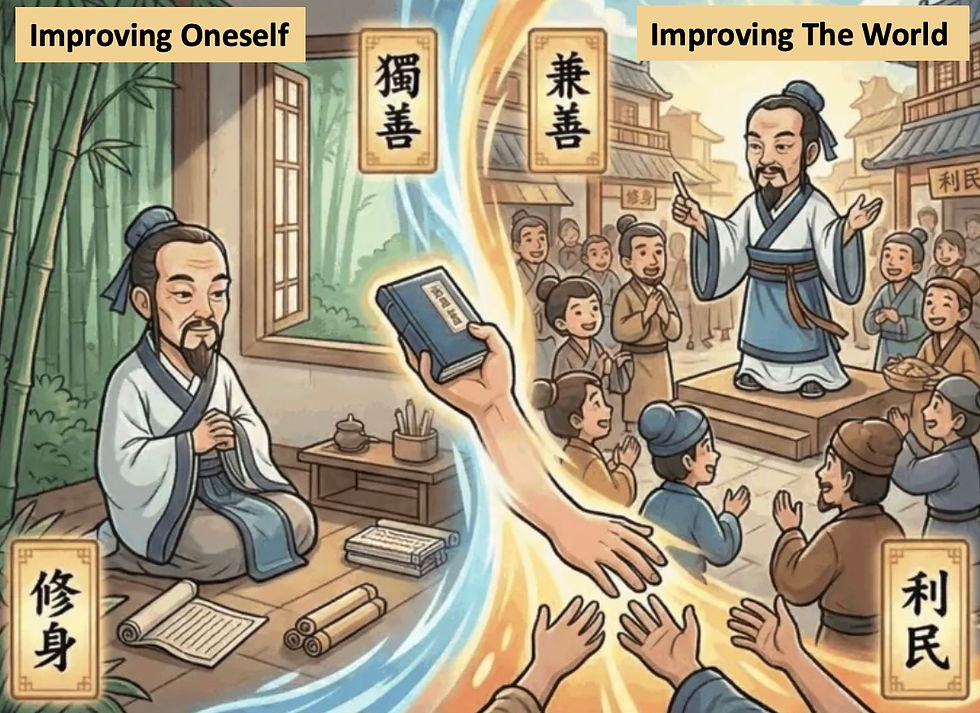
Later, Duke Jing came to power and allowed Yanzi to bring out his potential. I'm not sure how Duke Jing met Yanzi, but I imagine that when he came to power, he wanted to employ good ministers. Other ministers probably told him about Yanzi being very capable and wise. Thus, Duke Jing decided to meet Yanzi. Since Yanzi continued to hone his studies and abilities, when the Duke met him, he was very impressed by Yanzi. Of course, another key factor is that their aspirations also aligned, which is to benefit the people and rule through virtue.
Conclusion
From this story, we can learn to not be upset when others don't recognize our abilities, and instead focus on improving ourselves so that our abilities deserve to be recognized. We can also learn to be patient. If our current leader does not recognize our strengths, perhaps they will later, or another leader will in the future.
Weekly Wisdom #410


Comments