.jpg)
Human Nature Is Good Part 2 — I Didn't Mean To Hurt Your Feelings

Previously, I wrote about Mencius's theory on why human nature is good. His main idea is that all people have innate and natural feelings of
Compassion (towards those suffering)
Modesty (when over-praised)
Right and wrong (an inner conscience)
Shame (when doing wrong as deemed by the inner conscience)

Mencius calls these "the four sprouts" because they need nurturing to become a strong motive force. If we neglect these four sprouts, and instead nurture weeds like ego and anger, then of course, those weeds will grow. However, the four sprouts will always be there and will never completely perish. Even someone with big weeds can still choose to nurture the four sprouts and "revive" their innate goodness.
Understanding this idea is very important. When we truly believe that all humans have the potential for goodness, and that they just need us to water those four sprouts, we will treat people differently, which will then create results different as night and day in our relationships. I recently had an experience that confirmed Mencius's theory.
Story
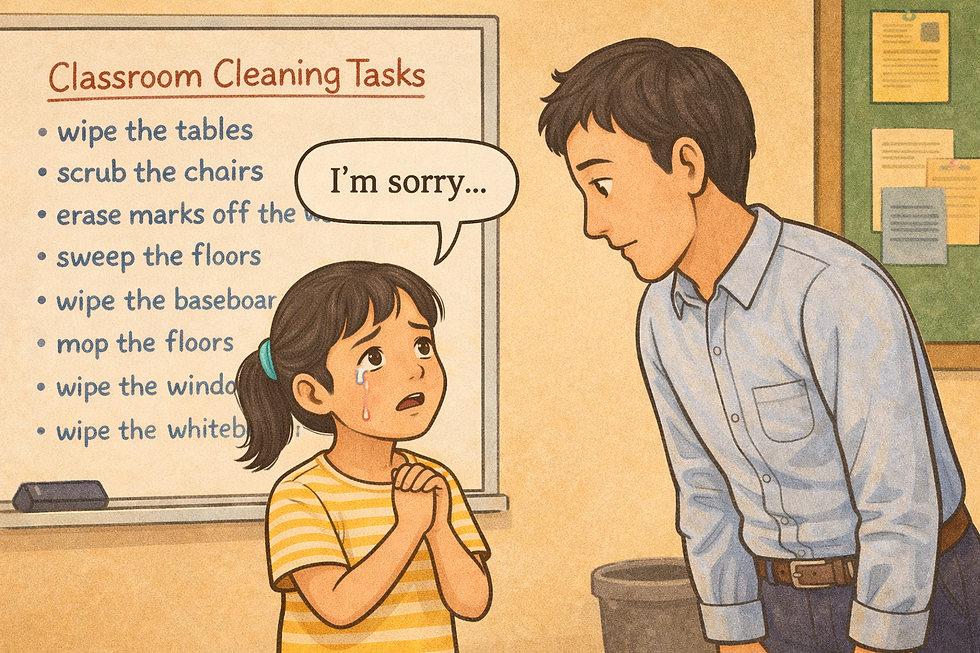
This past week at school, we were doing school-wide cleaning in preparation for a big event next week. I was leading a grade 3 class to clean their classroom. I first wrote on the whiteboard a list of things to do: wipe the tables, scrub the chairs, erase marks off the walls, sweep the floors, wipe the baseboards, mop the floors, wipe the windows, wipe the whiteboard.
I told them, "Today we have a big important mission! It's not going to be easy. We have to make this classroom spotless! Can you do it?"
They said, "Yes!"
I said, "OK, I split the mission into different tasks. Everyone, pick your task."
The students all picked their own tasks. It felt like a good start because the kids were willing to do this mission and picked their own task. I didn't force them to do anything.
For the first 10 minutes, everyone was doing their job. Then one of the students, Carol, told me, "I don't want to wipe tables anymore. It's boring. Can I do something else?"
For context, Carol is known as a trouble student in the school who often doesn't listen to teachers. I told Carol, "You picked this job, so you have to make sure this job gets completed. If you want to do another job, then you have to find a classmate who is willing to swap with you."
Carol then asked some other classmates, but no one was willing to swap with her. She then told me, "No one wants to swap with me. But I want to scrub chairs. That looks more fun."
I said, "OK fine, but if you scrub chairs with Mary, then both of you need to wipe the tables afterwards."
They both agreed.
Later, Carol started disturbing others, putting soap water onto already clean tables, and throwing towels at others. The school rule is that teachers give two verbal warnings, and the third one results in a time-out. In the span of 10 minutes, I gave her two verbal warnings, and then finally a time-out.
When I gave the time-out, it was near the end of school, so I said, "Time's up! Everyone except Carol, line up. I will take you out to the front door. Carol, you stay in the classroom and wait. I will tell your dad that you will come out late because you have a time-out."
Carol said, "Please don’t tell my dad! If you tell him, he’ll tell my mom, and then…” She started tearing up. When I saw this, I thought it was a good teaching opportunity to let her know that this is how she makes us teachers feel when she doesn't listen to us.
I said, “I know you’re upset right now, but have you ever thought that when I told you to not disturb others, to not throw towels around, and then you laugh it off like a joke, that you hurt my feelings?"
She said, "I'm sorry…"
I said, "What use is it to say sorry now? It's like if I use this push pin to poke a hole into this paper, when I pull it out, what's left? There's a hole. When you hurt my feelings, and then you say sorry after, there's still a hole. What can you do about it? How can you make it up? You think about it in the classroom. I'm going to take the other students out first."
After a few minutes, she came out on her own to find me. I was surprised, and I almost wanted to say, "Didn't I tell you to wait in the classroom?" But I saw on her face that she looked very apologetic, so I didn't say anything.
She said to me, "I know what I did was wrong, and I am really sorry for hurting your feelings. I promise I won't do it again. Please don't tell my dad."
I then replied, "OK. I know you didn't truly mean to hurt my feelings. I forgive you this time, and I won't tell your dad. But you have to pinky promise to me that you will remember: not listening to the teacher will hurt our feelings. OK?" We then did a pinky promise, and I let her leave.
Commentary
I was quite surprised that Carol came out of the classroom by herself and apologized so sincerely. Just earlier that day, I saw Carol standing outside the classroom because she had a time-out by another teacher, and on her hand she wrote "Bad", and her face looked angry.
I asked her, "Why do you have 'Bad' written on your hand?"
She said, "Because I'm a bad girl."
I said, "I don't think so. How about we erase that?"
She said, "No."
I then left her alone. Most people at school would think of Carol as self-centered, only wanting to play, hates being bored, and likes to imitate Kuromi (a cute, bad-girl version of Hello Kitty). Apparently, she used to be nice in the past, but after she got obsessed with Kuromi, she became a bad girl.
I think Carol is a prime example of how people have innate goodness, but if we neglect those good sprouts and instead water the weeds (in this case, she got obsessed with Kuromi), then they become bad. Aside from Kuromi, her parents also told me that they set a bad role model at home because they will fight and scream, so the kids probably learned that from them.
But despite all of these negative influences, her good sprouts are always there and can still be watered. If I had just said, "You're misbehaving. This is your third time. You have a time-out," that's not exactly watering her good sprouts. That's just reinforcing her idea that she's a bad girl.
But when I told her, "I know you feel very upset right now, but did you know that this is how you make me feel when you don't listen to me?" Suddenly, her sense of morality arises. Deep down, she doesn't want to hurt my feelings. (This is also because I try to be nice to her, and I often help her to open her lunch container or do cleaning, so she feels bad for hurting my feelings.)
Deep down, she has a sense of right and wrong, and she knows it's wrong to hurt the feelings of a teacher who is nice to her, so she naturally felt remorse. That's her innate goodness. When I said, "OK, I know you didn't mean to hurt my feelings, and I forgive you. Promise me that you won't do it again," that's watering her good sprouts.
Of course, her bad habits have already grown, and changing those bad habits isn't easy. I wouldn't be surprised if she doesn't listen to teachers and gets more time-outs in the future, but we don't have to view these events as "bad" or dread them. Rather, they are learning opportunities to help her water good sprouts and slowly starve the weeds. With time and persistence, her good sprouts can become stronger than the weeds.
Concluding Thoughts
When others do bad things, do we water their good sprouts or their weeds? What about for ourselves?
Weekly Wisdom #373


Comments