.jpg)
Human Nature Is Good Part 3 — I Thought I Could Trust You

Previously, I wrote about Mencius's theory on why human nature is good. His main idea is that all people have innate and natural feelings of
Compassion (towards those suffering)
Modesty (when over-praised)
Right and wrong (an inner conscience)
Shame (when doing wrong as deemed by the inner conscience)

Mencius calls these "the four sprouts" because they need nurturing to become a strong motive force. If we neglect these four sprouts, and instead nurture weeds like ego and anger, then of course, those weeds will grow. However, the four sprouts will always be there and will never completely perish. Even someone with big weeds can still choose to nurture the four sprouts and "revive" their innate goodness.
Understanding this idea is very important. When we truly believe that all humans have the potential for goodness, and that they just need us to water those four sprouts, we will treat people differently, which will then create results different as night and day in our relationships. Last time, I wrote a story about Carol, who likes to be a bad girl, but ultimately still has inner goodness and doesn't want to hurt others' feelings. This time, I have another story about trust.
Story
Since there's a big event coming up, we were doing school-wide cleaning every day this week. I was tasked with assigning which student does which cleaning job. Most of the students were tasked with cleaning their own classrooms with their homeroom teacher. I felt there were two students who were very reliable, so I assigned them to the hardest job: cleaning the reception hall with another teacher.
The second most important job is probably sweeping and mopping the common areas. I picked two students who I felt were decently reliable, and since there were no more very reliable students left, I picked John, who is a strong 7-year old boy with lots of energy. If he's in a good mood, he's reliable, but if he's in a bad mood, then no one can get him to do anything, not even the principal or his parents. I felt that at worst, if he is in a bad mood, at least the other two students could get the job done.
When it came time for cleaning, another teacher needed to talk to those two decently reliable students, so it was just me and John. John already went to get the big mop. I said, "John, why did you get that mop? That's for adults. You should get the student mop."
He said, "I want to use this one."
I decided to not argue. The fact that he is willing to mop is already a blessing.
I said, "Alright, fine. Since the other two students will be late, I will start sweeping first, and you can mop the areas I've swept."
I first swept one area, and John mopped it. I then swept the library area, and I asked John to mop it while I swept another area. A few minutes later, I saw John lying down on a library bench reading a book. I came over and said, "What are you doing? I thought you were mopping. Why are you reading?"
He didn't look at me and just continued reading his book.
I said, "John, when the teacher is talking to you, who do you look at?"
He got annoyed and said, "I don't want to mop anymore. It's boring."
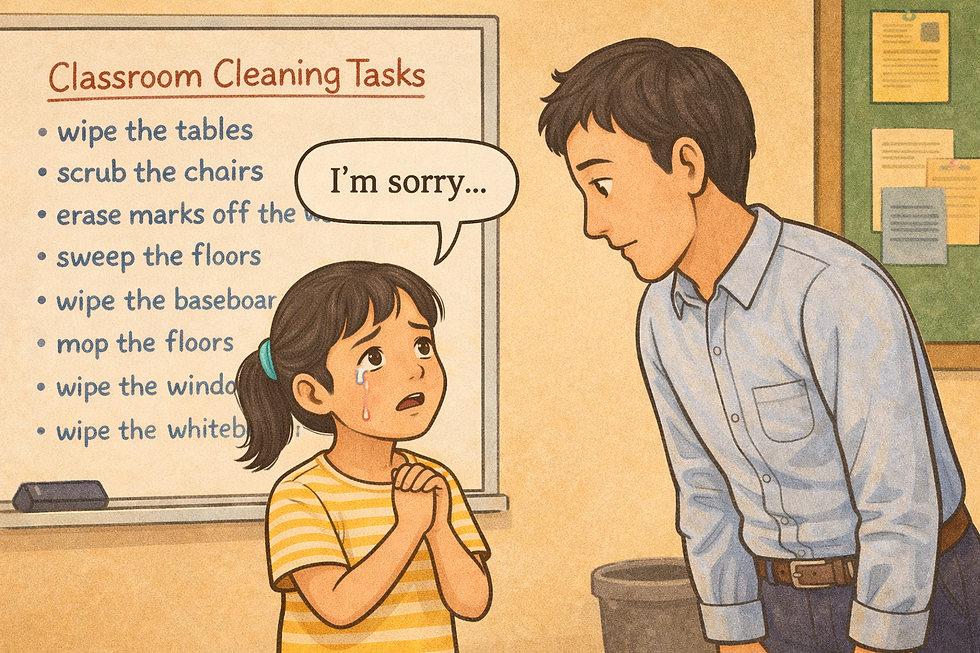
I told him, "John, do you know why I chose you to mop with me? It's because I thought I could trust you. Do you know what trust means? It means that if I give you a task, I trust that you can do it. It means that if you say you will do something, you will definitely do it. If you want to tell me, 'Sorry, you cannot trust me,' then fine, you can go wait in the office, and I'll find someone I can trust to help me mop the floors."

He then let out an unhappy grunt, reluctantly got off the bench, and started mopping with a lot of force. I continued sweeping, and he collaborated with me until we finished all the work. In one of the rooms, the floors had some black marks, and I told him to re-mop those areas multiple times. He actually listened with any complaint. Normally, he likes to rush his cleaning job and run away to play without asking me to check his work. But today, he patiently stayed with me until the very end, until I said we are done.
Commentary
John is notorious for his stubbornness and self-centeredness. When he doesn't want to do something, no one can do anything about it. I've talked about this with his parents, and they said he's the same at home, and they really struggle with that.
But John still has an innate sense of right and wrong, as well as a sense of shame. When I told him, "I picked you for this job because I thought I could trust you, but it seems like I was wrong," he felt bad. It's human nature to want to be someone worthy of others' trust, to not want to let others down.
Although his weeds of self-centeredness are strong, my words awakened his good sprouts, and he became very motivated and responsible afterwards. Later, I told him that I was very happy to see him so motivated and very impressed to see him do his job so thoroughly. This is watering his good sprouts.
One thing with goodness is that we shouldn't force others to be good. That's like pulling on the sprouts to make them grow. It would only kill the sprouts. Instead, we need to awaken their goodness naturally. To do that, we have to have trust in them, to be willing to have our feelings hurt when they violate our trust, and then sincerely tell them that they hurt our feelings.
If I had said to John, "Stop reading books and go finish your mopping job now. You are supposed to be trustworthy," then John would probably rebel. But I was truly disappointed in him, and I was truly ready to find someone else to replace him. That's what awakened his sense of shame.
Of course, bad habits don't disappear suddenly, and I'm sure he'll still have those stubborn moments in the future, but his good sprouts will always be there, and we can use these conflicts to water those good sprouts.
Concluding Thoughts
Do you show others trust or doubt? Do you force goodness out of others or awaken it?


Comments