.jpg)
The Stickler Servant — A Story On Flexible Versus Rigid Learning

A long time ago, there was a man was not well educated and could not do any kind of work, so he had no choice but to become a servant. Before he started work, someone taught him some rules.
“Firstly, when walking, never walk in front of your master. Got it?”
“Got it!”
“There’s another important rule, and it has its advantages too. Your things are not to be used by the master. But you may use your master's things. Got it?"
“Got it!”
“And one more rule: when the master is eating, you must not eat first. After the master has finished, whatever is left over, you eat. Got it?”
“Got it!”

After memorizing these three rules, he started working as a servant.
One evening the master was out on the road, and dinner was already prepared at home. In those days it was dark at night and there were no electric lights, so the family said, “So-and-so, take a lantern and go pick up the master.”
The servant went out and met the master on the road. Carrying the lantern, he ran behind the master. The master said, “Hey! What are you doing? Go in front!”
The servant replied, “No, no, no, I can't!”
No matter what the master said, he refused, because the rule he had learned was that he must stay behind the master. As a result, the master was very irritated walking in front with no light.

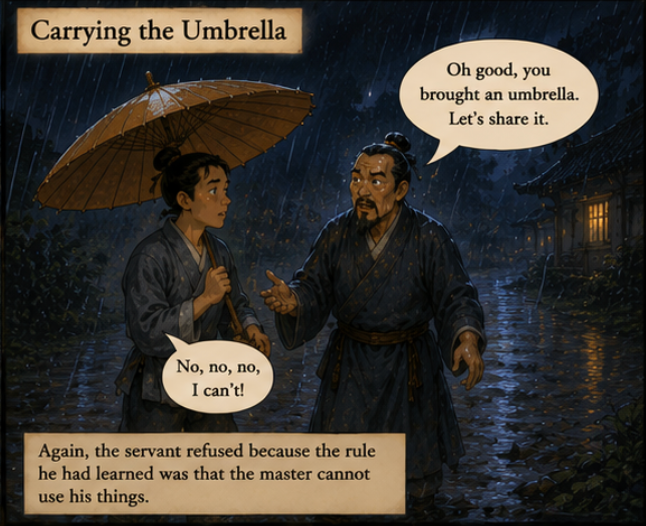
Another day, the master went out again. It was late and raining, so the family told the servant to take an umbrella to pick up the him. Carrying the umbrella, he met the master on the road. The master had no umbrella and said, “Oh good, you brought an umbrella. Let’s share it.”
The servant replied, “No, no, no, I can't!”
Again, the servant refused because the rule he had learned was that the master cannot use his things.
After returning home, the master was extremely displeased. Even the mistress could not calm him down. Their argument upset their child, who began to cry. The adults quickly soothed the child and gave him a bowl of milk to drink.
After the child finished drinking, there was some leftover, and this servant immediately ran over and started drinking the leftovers himself. Why?
Because it was “what the master had left over”!
As for what happened to that servant later, we can all probably guess.

(Story translated from Professor Xu's Commentary on The Essentials of Common Propriety)
Commentary
While we may laugh at this stickler servant, we should also reflect on ourselves. Are we good students? If we want a happy life, then being a good student at moral learning is key. If we want a successful career, then being a good student in our field is key. No matter our situation, learning is an important ability we ought to develop.
In the Analects, Confucius said,
"Learning without thinking leads to confusion. Thinking without learning leads to trouble."
(Original text: 學而不思則罔,思而不學則殆。)
In moral learning and cultivation, we can't just learn the surface-level matter. We have to grasp the underlying principle and spirit behind the matters. There is never a one-size-fits-all approach, and every rule has its exceptions. Thus, it's very important for us to contemplate "Why?" towards rules and to check our understanding with experts. Only when we understand why can we judge when to make exceptions.
In the Optimality Principle, Confucius also gave a sequence for moral learning:
"Learn deeply and broadly, inquire thoroughly, think carefully, discern clearly, and practice earnestly."
(Original text: 博學之 審問之 慎思之 明辦之 篤行之)
The first step is to start learning about a topic, and we aim to learn extensively. In the process of learning theory, we need to inquire thoughtfully and thoroughly. Engage with the content. Ask questions.
Third, we need to think carefully about the content and the answers to our questions. What is the matter, the reasoning, and the intention? How can we apply these teachings in our daily life? We also need to discern clearly what is true in which situations and in which situations there may be exceptions.
The previous four steps are all part of the process of understanding and digesting the theory that we learned. What is the purpose of understanding? To practice earnestly. Only through action can we truly benefit. Thus, the previous four steps are all for the purpose of our practice in daily life. Understanding and practice mutually feed each other.

In this story, the person who advised the servant gave reasonable rules that would normally be suitable. However, the servant only focused on the matters of the rules without understanding the underlying reason or principles behind the rules. As a result, he didn't make exceptions when he should have.
For the first rule, indeed, we should usually walk behind the master to show our respect. After all, it's the leader that leads in front, and the follower follows behind. The leader gets to set the walking pace, not the follower. If the leader wants to stop, the followers stop too. The principle and spirit here is respect and deference.
But when it is dark, the servant needs to serve the master by lighting the path ahead for the master. So when we walk behind the master, it's to show our deference and respect. When we walk ahead to light the way for the master, it's also to show our deference and respect. Although the actions seem opposite, the intention is the same: respectful service.
Can you think of other situations where the servant should walk ahead of the master?
In our learning, we also need to be able to make connections and inferences. If we cannot, then our learning is stiff and rigid; we're just memorizing matters, not internalizing principles and spirit. Matters are infinite, and trying to memorize them one by one is poor learning. If we internalize the principle and spirit, then we'll be able to respond to all matters appropriately.
One example I can think of for when we should walk ahead of others is when we approach a door. The servant should then rush ahead to open the door for the master. Another example might be walking down a rocky path. The servant could walk ahead to check the safety of the path for the master.
Although we're using the example of a servant and master here, it's not limited to these two roles. When we're with anyone else, we can view them as either our superior or junior. Towards parents, teachers, leaders, as well as elder siblings and friends, we can treat them the way a servant treats a master: with an attitude of service and respect.
The second rule was that the servant is allowed to use the master's things, but the master is not allowed to use the servant's things. Why? I think the master shouldn't use the servant's things because we want to help the master maintain his image. If the master uses the servant's things, people might think he is a servant, not a master. On the other hand, the servant can use the master's things because the servant needs to do work for the master, and that sometimes requires using the master's things.
If the servant understood this spirit, then when he went to pick up the master in the rain, he would've thought to take the master's umbrella instead of his own, or take both umbrellas. Which option is better? Well, if the master's umbrella is big enough, and the rain isn't too heavy, then I would just take the master's umbrella and hold the umbrella for him. If the master's umbrella is small or the rain is quite heavy, then I would take two umbrellas for better rain protection. Thus, we can see how actions are very flexible and need to adapt to the complex situation, but the intention is still the same.
Another important point is that the master even ordered the servant to walk ahead with the lamp and to share the umbrella. This should be the trump card that trumps all rules. If the master orders something and insists on it, we obey. Hence the saying,
"Respect is inferior to obedience."
When elders ask us to do something, like going first instead of waiting for them, and then we say "No no no, you first", we might think we are being respectful, but actually obeying the elder's orders is true respect. Of course, this requires us to observe the situation and sense the elder's true feelings. Sometimes, they are just being polite; other times, they really mean it. We can't rely on rules. We have to use our judgment and sense what's appropriate for each unique situation.
The third rule was that the servant mustn't eat before the master, and whatever is leftover, the servant eats. Why? Of course, the spirit is respect, but what's the reasoning behind the matter? Well, when the most important person should eat first. Therefore, the master eats before the servant. This is also why children should wait until their elders start eating before they start eating.
Why should the servant eat the leftovers? Again, the spirit here is deference and not wanting to add trouble to the master. Whatever food the master has, the servant eats. The master isn't going to cook separate food specially for the servant. Moreover, the master doesn't want to waste food, so whatever is leftover, the servant helps to eat. It's also possible that there are certain delicacies that the master wants to save for later, and he might tell the servant to not eat that. Every rule has its exceptions.
If we understand the spirit is respect, then we would be able to infer other actions. What inferences can you think of?
For one, we would observe their glass and plates. When they are low on water, we could promptly and proactively pour some for them. If we see they really like a certain dish, we could get more of that dish for them. When we bring that dish close to them, we observe their reaction. They might look pleased, or they might look displeased. Based on their reaction and words, we would know if they truly want it or not. We should also try to eat at a similar speed to elders. If we eat too fast, they feel pressured to eat faster. If we eat too slow, then they end up having to wait for us. These are just a few examples of inferences.
In the story, the food was milk for the baby. It's kind of strange for the servant to eat baby food because that food was never meant for him. It's basic social intelligence. The stickler servant was a great example of a bad student. We learn from his mistakes to become better students ourselves.
At the same time, we should also learn from good role models. Venerable Master Jing Kong is a model of an exemplary student. He is renowned for lecturing on complex Buddhist sutras in an easy-to-understand manner. The teacher who taught him was Mr. Li Bingnan, and Venerable Jing Kong once said,
"When I listened to Mr. Li lecture on the Flower Adornment Sutra, I only heard the first volume. Yet after hearing that first volume, I was able to lecture on the remaining eighty volumes myself. Why? Because I understood my teacher’s way of thinking, his ideology, and his methods.
What kind of mindset should be used in lecturing? What methods should be used? Such things are alive and flexible; they cannot really be taught directly. What is required is long-term close attendance upon the teacher, never missing a single class. Gradually, through continual observation and reflection, you come to understand these things yourself. It is not that the teacher refuses to teach—it simply cannot be taught explicitly.
By listening over a long period, constantly pondering and reflecting, you gradually gain insight and realizations, and then you can apply it flexibly on the lecture platform yourself. If you only learn fixed explanations sentence by sentence, then your method is rigid and dead. It cannot adapt, and it cannot suit the capacities of different audiences."
Conclusion
The stickler servant was a great example of how to be a bad student: follow rules rigidly without asking why.
If we want to be good students in moral learning on how to be a good person and have a happy life, then we need to learn not the matters, but rather the principles, reasoning, spirit, and intentions behind the matters. In this way, we can learn one matter and infer many more. This kind of learning is alive and flexible. It brings us insights and realizations, which is a joyful experience.
In order to grasp the principles and spirit, we need to inquire thoroughly, think carefully, and discern clearly. We also need long-term observation of good teachers and role models, as well as self-reflection and earnest practice.
When we understand one point, we practice one point. From practice, we reflect and gain further understanding, which then improves our practice next time. Practice and understanding fuel each other, and through the process, we will experience the joy of moral learning and growth.
As Confucius said in the opening line of the Analects,
"To learn and constantly practice what one learns, is this not joyful?"
They key, of course, is that we know how to learn.
Weekly Wisdom #394


Comments