.jpg)
Daily Stoic January Review — Clarity

The Daily Stoic is a book with 366 quotes from Stoic philosophers on how to live a good life. I had previously read this a couple years ago and benefited a lot from it, and I've decided to read it again this year. Every day, I read the quote, the explanation, and then journal my thoughts and reflections. At the end of each month, I review my reflections and summarize the month. January just finished, so this article will summarize my January reflections.

1: To walk the path of life effectively, we have to focus on what we can control and not what's outside our control.
Jan 1:
"The chief task in life is simply this: to identify and separate matters so that I can say clearly to myself which are externals not under my control, and which have to do with the choices I actually control. Where then do I look for good and evil? Not to the uncontrollable externals, but within myself to the choices that are my own."
—Epictetus
Jan 9:
"Some things are in our control, while others are not. We control our opinion, choice, desire, aversion, and, in a word, everything of our own doing. We don't control our body, property, reputation, position, and, in a word, everything not of our own doing. Even more, the things in our control are by nature, free, unhindered, and unobstructed, while those not in our control are weak, slavish, can be hindered, and are not our own."
—Epictetus
Focusing on what we can control sounds simple and obvious, but if we look around, who actually practices it? So many people get upset and worried about things outside of their control. This one shift in mindset is key to reducing negative emotion and increasing inner peace.
Adding the teaching of causality here is very useful. Every result has its causes and condition.
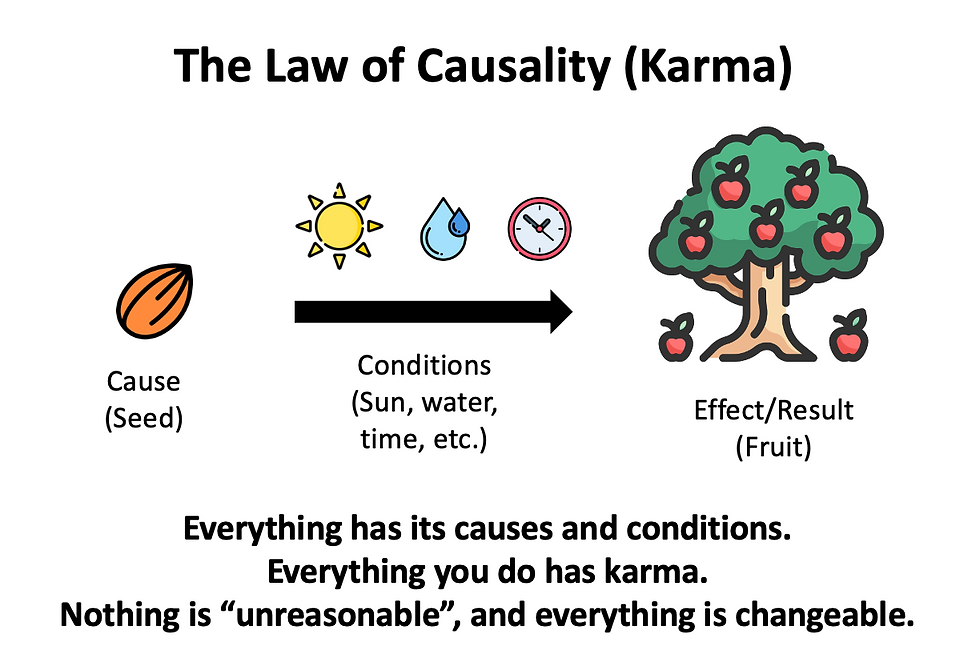
For example, if someone treats me rudely today, that's a result. To get upset about it is both illogical and a waste of energy.
It's illogical because the result definitely has its cause and conditions, meaning it is reasonable. Perhaps they had a bad day. Perhaps we mistreated them in the past. Perhaps they learned rude behavior from years of observing rude elders. We are upset because we think it's not reasonable, but there is definitely a reason for it. The current result and past events are outside of our control, so getting upset is a waste of our energy. But we can control our reaction, which plants the seeds for the future.
If we want to improve our relationship with them, we can take initiative to treat them well. If we want to improve our emotional stability, then we practice shifting our thoughts to something like, "What others do is their matter. But my feelings are my matter. I can choose how I feel regardless of what others do."
Thus, focusing on what's in our control is a good use of our energy. Not only does it help us to regain peace in the present, but it also helps us to create a better future.
My Practice:
I used to complain a lot. But after I did the 21-Day No Complaint Challenge years ago, I started to re-train my thoughts. If a thought of complaint arose, I would talk back at it with proper thoughts like "Focus on what's in my control" and "Use the law of causality to analyze this situation". After many years, I now complain much less, and my emotions are a lot more stable.
2: Why learn and practice philosophy? Because it brings us freedom and tranquility.
Jan 2:
"What is the fruit of these teachings? Only the most beautiful and proper harvest of the truly educated--tranquility, fearlessness, and freedom…Only the educated are free."
—Epictetus
Jan 31:
"Don't return to philosophy as a task-master, but as patients seek out relief in a treatment of sore eyes, or a dressing for a burn, or from an ointment. Regarding it this way, you'll obey reason without putting it on display and rest easy in its care."
—Marcus Aurelius
Everyone just wants to be happy in life. But a lot of us don't know where true, long-lasting happiness comes from. A lot of people chase external pleasures, like food, parties, games, TV, excitement, etc. But these are all fleeting pleasures. After the external stimulation is gone, we feel empty, and we might need more stimulation next time to feel the same level of pleasure.
Ancient philosophers taught that true happiness comes from good relationships and self-improvement. The former is a result of the latter, meaning that improving oneself is the root of long-lasting happiness. If we can manage our emotions better, make better decisions, behave and speak better, then of course our life will flourish. Hence why Epictetus said learning (and practicing) philosophy brings us tranquility, fearlessness, and freedom.

Right now, we have problems that create unhappiness and suffering, problems such as bad emotional management, lack of wisdom to make decisions, and ineffective speech and behavior that leads to conflict and problems. Thus, learning philosophy is not for fun, it's to treat our illnesses so that we can return to health.
My Practice:
I reflect on myself every day using a merit-fault journal. I pick the list of virtues I want to cultivate and vices I want to correct. When I practice those virtues, I give myself a point. When I commit wrongdoings, I subtract a point. This is a great way to keep myself accountable on my journey of self-cultivation.
3: To walk the path of life effectively, we have to know our priorities and be able to say no.
Jan 3:
"How many have laid waste to your life when you weren't aware of what you were losing, how much was wasted in pointless grief, foolish joy, greedy desire, and social amusements—how little of your own was left to you. You will realize you are dying before your time!"
—Seneca
Jan 5:
"Let all your efforts be directed to something, let it keep that end in view. It's not activity that disturbs people, but false conceptions of things that drive them mad."
—Seneca
A lot of people are unconsciously running on a rat wheel, busy from morning to night with the same routine, but not seeming to make any progress. It's tiring. It's unproductive.
But few people say, "Enough", jump out of the rat wheel, and think long and hard about where it is they want to go and what is truly essential. Once we know our goal, we can then return to the rat wheel of daily life. Except now, it won't be mindless activity, it'll be intentional action.
My Practice:
Every day I reflect on the virtue of "proper prioritization". As the Great Learning says,
"To know what comes first and after is to be near the Way."
I also know my short-term and long-term goals, and I can connect what I do today to those goals.
4: Overcome addictions
Jan 8:
"We must give up many things to which we are addicted, considering them to be good. Otherwise, courage will vanish, which should continually test itself. Greatness of soul will be lost, which can't stand out unless it disdains as petty what the mob regards as most desirable."
—Seneca
Jan 16:
"So in the majority of other things, we address circumstances not in accordance with the right assumptions, but mostly by following wretched habit. Since all that I've said is the case, the person in training must seek to rise above, so as to stop seeking out pleasure and steering away from pain; to stop clinging to living and abhorring death; and in the case of poverty and money, to stop valuing receiving over giving."
—Musonius Rufus
My Thoughts:
I used to chase external pleasures such as delicious food, video games, and TV shows. An appropriate amount of these things are fine, but we have to be cautious against getting addicted. If we start thinking about these things all the time and feel a strong sense of craving, then we are slipping into addiction.
Aside from external things being addictions, our way of thinking can also be an addiction. Some people habitually think negatively. Some people are addicted to anger. Such habits, as Musonius said, are "wretched". They create a lot of suffering for ourselves. Philosophy is not for talk. Philosophy is action and practice. Changing these bad habits is the work of philosophers and self-cultivators.
James Clear said,
“The quality of our lives depends on the quality of our habits.”
Since so much of our daily life is driven by habit, if we can consciously cultivate good habits and eliminate bad habits, our life would change drastically.
My Practice:
I've read a lot about habit change, and I summarized the best practices and my own experience in the article How to Build Healthy Habits that Stick and Break Bad Ones.
5: Reflect Daily
Jan 22
"I will keep constant watch over myself and—most usefully—will put each day up for review. For this is what makes us evil—that none of us looks back upon our own lives. We reflect upon only that which we are about to do. And yet our plans for the future descend from the past."
—Seneca
At the end of each day, Seneca would ask himself, "What bad habit did I curb today? How am I better? Were my actions just? How can I improve?"

A major difference between self-cultivators and non-cultivators is that self-cultivators are trying their best to be constantly aware of their every thought, speech, and action, and are intentionally trying to improve. Non-cultivators just follow their personality and habits, and so those bad habits grow. This is a standard to judge if we are true philosophers or not.
To help us develop this awareness, daily written reflection is essential. As management guru Peter Drucker said,
"What gets measured gets done".
I would add, what gets recorded is remembered. When we record our mistakes and how we will improve next time, we are more likely to actually improve next time.
Theoretically, if we improve by just 1% a day (a little a day), that would be a 365% improvement in a year. But improvement is not easy. Growth requires intentional effort, while regression just requires us to forget about cultivation. Even with intentional effort, we might still regress. But if in a week we could average a 1% improvement, that would still be a 50% improvement in a year! A caveat is that growth isn't linear. As we level up, it becomes exponentially harder to grow. But as long as we persist in our cultivation, we will definitely maintain an upward trend.
My Practice:
I have been writing in my merit-fault journal for many years now. In some aspects, I feel like I have plateaued a bit, so it takes a lot to reach the next level. But through perseverance, at least my trend won't go downwards. In other aspects, there is still lots of room for improvement.
Conclusion
January's main theme is clarity: getting clear on what Stoic cultivation is, its goals, results, matters, and methods.
Goal and results: true happiness, freedom, and tranquility; curing the illnesses of the mind.
Matters: correcting our bad habits and addictions.
Method: always focusing on what's in our control; daily self-reflection.
Have you read the Daily Stoic as well? What are your thoughts and reflections?
Weekly Wisdom #380


Comments